Measuring g with a pendulum
How close can we get to acceleration due to gravity g=9.80665 m/s^2 at home, in an hour?
Theory
Quick - let’s first solve it analytically.
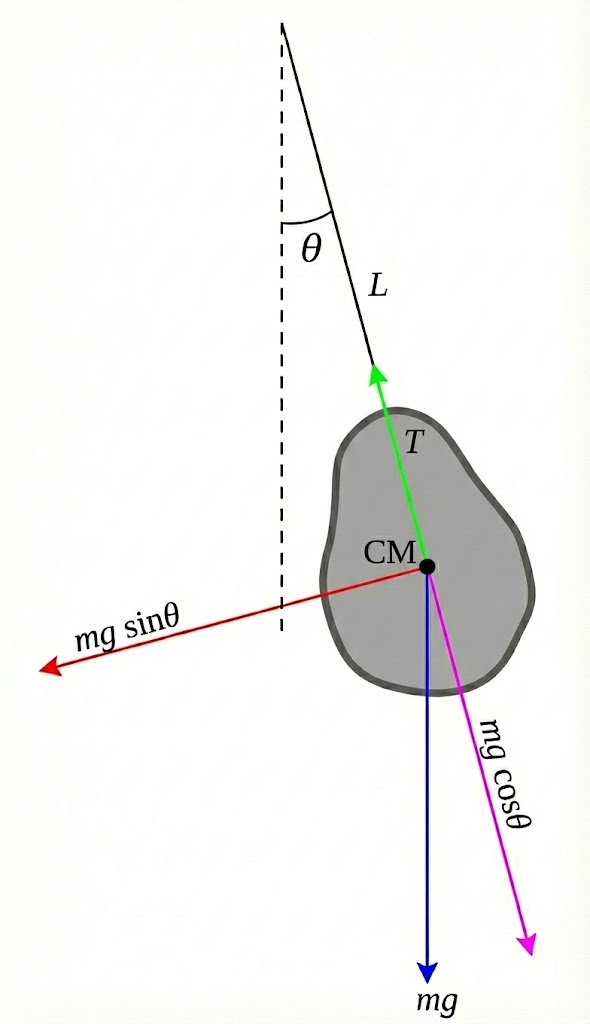
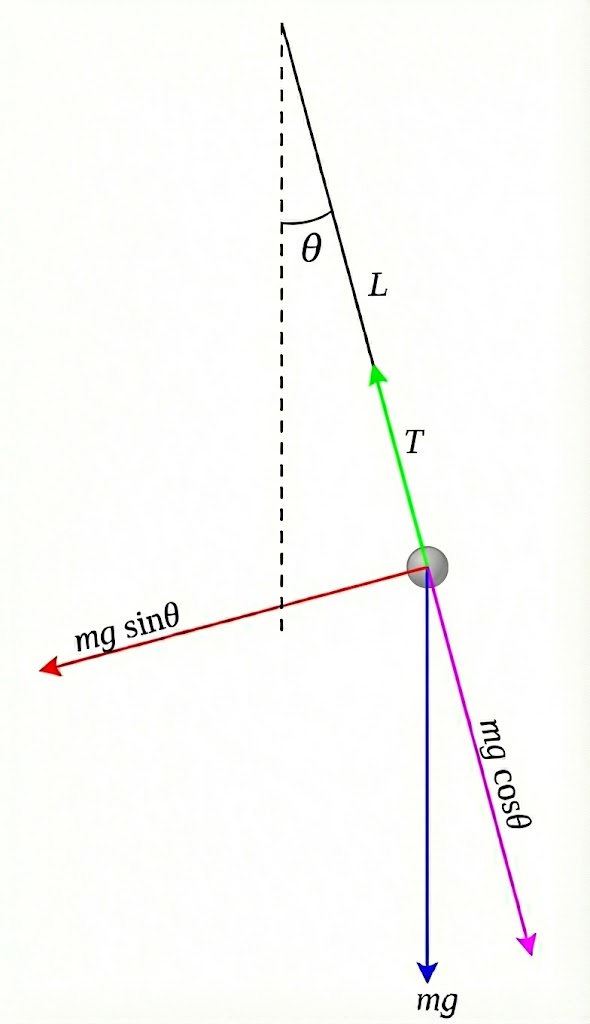
Second law says
With small angle approximation (), this gives
and since , the period is .
The problem says to use simple pendulum (point mass as the bob), so . Substituting, we get
Now solve for :
So all we need to do is measure the string’s length and the period . Simple, right?
Attempt 1: Collecting data (running into reality)
The only materials we need are a string, a pendulum bob, and a stopwatch.
I didn’t have any ideal object with simple moment of inertia, so I thought I’d first try to just use a longer string and let the in dominate.
And for the bob, I needed the densest thing around to remove the effect of string’s mass: my character this lotion bottle.
I took 5 trials of 10 periods each (let nature do the summing to reduce uncertainty).
| Trial | Time for 10 periods (s) | Period (s) |
|---|---|---|
| 1 | 15.45 | 1.545 |
| 2 | 15.36 | 1.536 |
| 3 | 15.47 | 1.547 |
| 4 | 15.40 | 1.540 |
| 5 | 15.39 | 1.539 |
| Average | 15.414 | 1.5414 |
I only had the edge of protractor as my ruler, and the bob was already tied up, so it was a real pain to measure . It came out, after 3 back-to-back measurements, to be ~14 inches or 35.6 cm.
Substituting into the equation, we get.. *drumroll*
What??
Attempt 2: Debugging, irl
What could be wrong?
- Friction from the string: probably not much—10 oscillations don’t show noticeable damping
- Air drag: same as above, though drag would increase period, and , which is in the direction of the error. hm.
- String’s mass: definitely negligible compared to the mass of the bob.
- Small angle approximation: angle was already very small.
- Lotion’s moment of inertia NOT a point mass <- this is probably it; is still pretty large compared to .
- L is too uncertain <- I need a better way to measure than back-to-back guesstimates.
Time for round two.
This time I marked string’s length exact with the edge of a sheet of paper (11 x 8.5in) and accounted for a little 0.5cm leftover when tying:
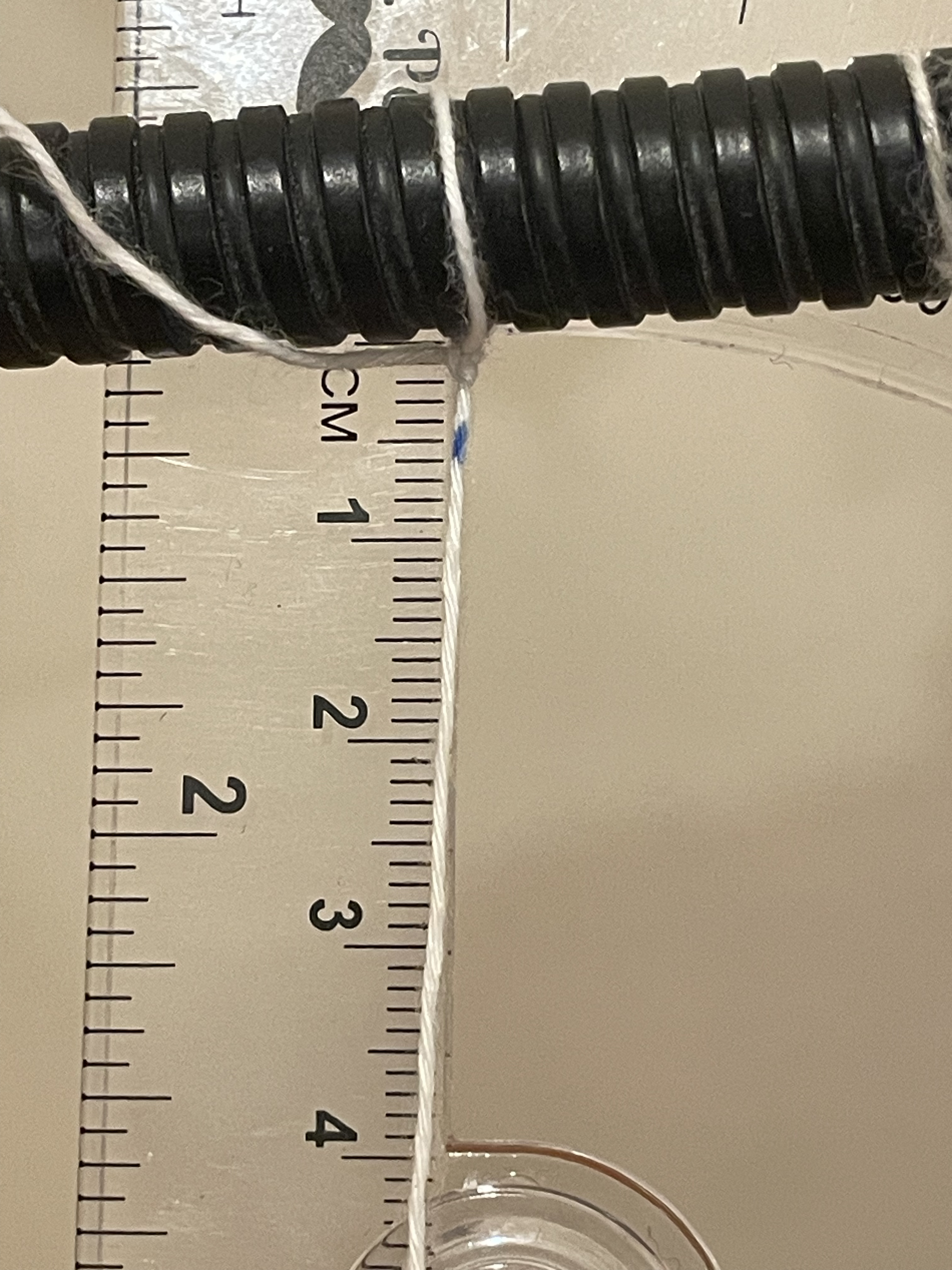
Also adding in an extra ~1cm from the string to the paperclip’s CM, we get
To get a smaller , I used a small binder clip on one end. Voila:
After 10 minutes of eye-drying focus, I finally got 5 trials of 10 periods each:
| Trial | Time for 10 periods (s) | Period (s) |
|---|---|---|
| 1 | 11.07 | 1.107 |
| 2 | 11.07 | 1.107 |
| 3 | 11.12 | 1.112 |
| 4 | 11.10 | 1.110 |
| 5 | 11.16 | 1.116 |
| Average | 11.104 | 1.1104 |
Now do I just use the average period ?
I tried playing the reaction time game a few times and found my delay to be ~0.2s. Since I start the stopwatch right as I let go, there’s no delay there. It’s not symmetric. Let’s subtract from the average:
Ok, but before we calculate the new , let’s find its uncertainty.
Uncertainty analysis
How far off are we?
The uncertainty in is . The uncertainty in is my reaction time of .
We can write as and repeatedly apply , like a chain rule.
Results
Putting all that together…
huzzah it worked!! sort of. it doesn’t exactly contain , but not too bad.
(maybe things are just further from Earth’s core where I live :P)
Wow it’s been so long since I’ve built something physical. I think I’ve gotten so addicted to the braincandy of reading new theory and so used to just manipulating equations / imagining on paper that I’d forgotten how fun it is to actually get outside and poke reality.